

UV Technology

1) How does UV Disinfection Work?

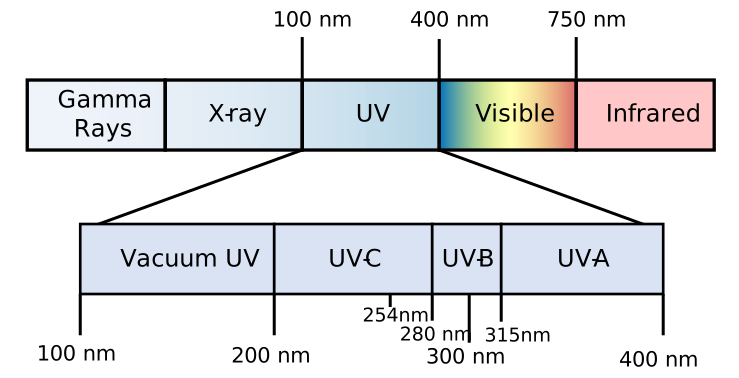
Ultraviolet (UV) light is a form of electromagnetic radiation with wavelengths ranging from 100 to 400 nanometers (nm). Naturally present in sunlight, UV radiation contributes to the inactivation of microorganisms in the environment.

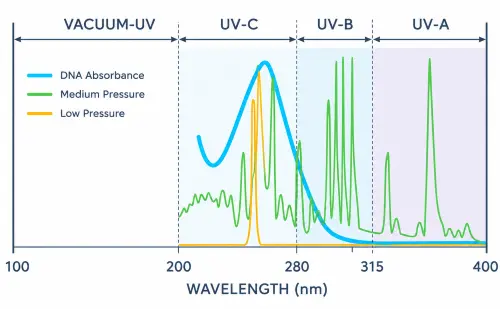
UV disinfection systems use specially designed lamps, such as mercury or amalgam lamps, to generate germicidal UV radiation. The wavelength of the light from the lamps is in the range of 200-400 nm for medium pressure and 253.7 nm for low pressure.

This radiation damages the DNA or RNA of bacteria, viruses, and protozoa and inactivates them by preventing them from reproducing.
UV Light Spectrum

2) UV Dose and Validation

UV dose is the amount of UV energy delivered to microorganisms during treatment.

For municipal wastewater disinfection, UV doses can range from 20 to 40 mJ/cm² or higher, depending on water quality and regulatory requirements. Drinking water applications commonly use doses of 30 to 40 mJ/cm².

Third-party bioassay validation establishes the operating limits of a UV system, including validated flow rates and UV transmittance (UVT) ranges, to confirm that the system achieves the required disinfection performance under specified conditions.

Neotec UV's systems have undergone third-party validation under frameworks such as California Title 22, UVDGM, and DVGW, demonstrating performance in accordance with their respective requirements.

3) Key factors to evaluate UV Disinfection

When assessing a UV disinfection system, several water quality and operating parameters must be evaluated.

‍1. UV Transmittance (UVT)
‍
UVT indicates how easily UV light passes through water at a specific wavelength. Lower UVT reduces UV penetration, making it more difficult to achieve the target UV dose.
‍
‍2. Suspended Solids (SS)
‍
Suspended solids can absorb or scatter UV light and shield microorganisms from exposure. UV disinfection is therefore generally installed toward the end of the wastewater treatment process, after suspended solids have been reduced through upstream treatment.
‍
‍3. Target Microorganisms
‍
The target microorganism(s) determine the required level of disinfection. Different bacteria, viruses, and protozoa have varying susceptibility to UV radiation, so the required UV dose depends on specific treatment objectives.
‍
‍4. Flow Rate
‍
Flow rate determines the volume of water that must be treated within a given period. Peak flow rate is a key factor in system sizing because the UV reactor must provide the required disinfection performance under maximum operating conditions.

4) UV vs. Conventional Chlorination

Compared to conventional chlorination, UV offers key operational and environmental advantages:
‍
• No chemical storage or dosing required
• No residual chlorine or chlorine-related byproducts
• Prevents chlorine-induced degradation of polyamide membranes used in reverse osmosis and nanofiltration
• Fast treatment with contact times measured in seconds while chlorination requires 15-30 minutes
• Reduced footprint and simplified operation
‍
Chlorination can react with organic matter in wastewater to form disinfection byproducts (DBPs), some of which are associated with potential health risks, including cancer. Although dechlorination removes residual chlorine before discharge, it does not remove DBPs already present during chlorination.

5)  Low- and Medium-Pressure Lamps

Medium-pressure lamps typically operate at powers above 1 kW and emit across a broader UV spectrum around 200-400 nm, while being more compact.

Low-pressure High-Output (LPHO) lamps emit primarily at 253.7 nm. They generally offer longer service life and lower energy consumption.

Medium-pressure lamps are often used in UV advanced oxidation processes (UV-AOP), where the broader range of UV wavelengths can contribute to more photochemical reactions.
Medium vs. Low-pressure Lamp Wavelength
Graph showing differences of wavelengths of medium and low pressure UV lamps.

6) Mercury and Amalgam UV Lamps

Conventional medium- and low-pressure UV lamps use mercury vapor to produce UV radiation.

Amalgam UV lamps are a type of LPHO mercury lamp that uses an alloy component to regulate mercury vapor pressure. This allows for higher UV output and more stable performance across a wider temperature range.